
Discover Your Heritage
From the weightless luxury of pure Pashmina to the regal drape of Toosha, find the piece that tells your story. Every thread is a tribute to centuries of Kashmiri artistry.
Visiting from Bangladesh? Switch to our Bangladesh Store for local delivery and BDT pricing.
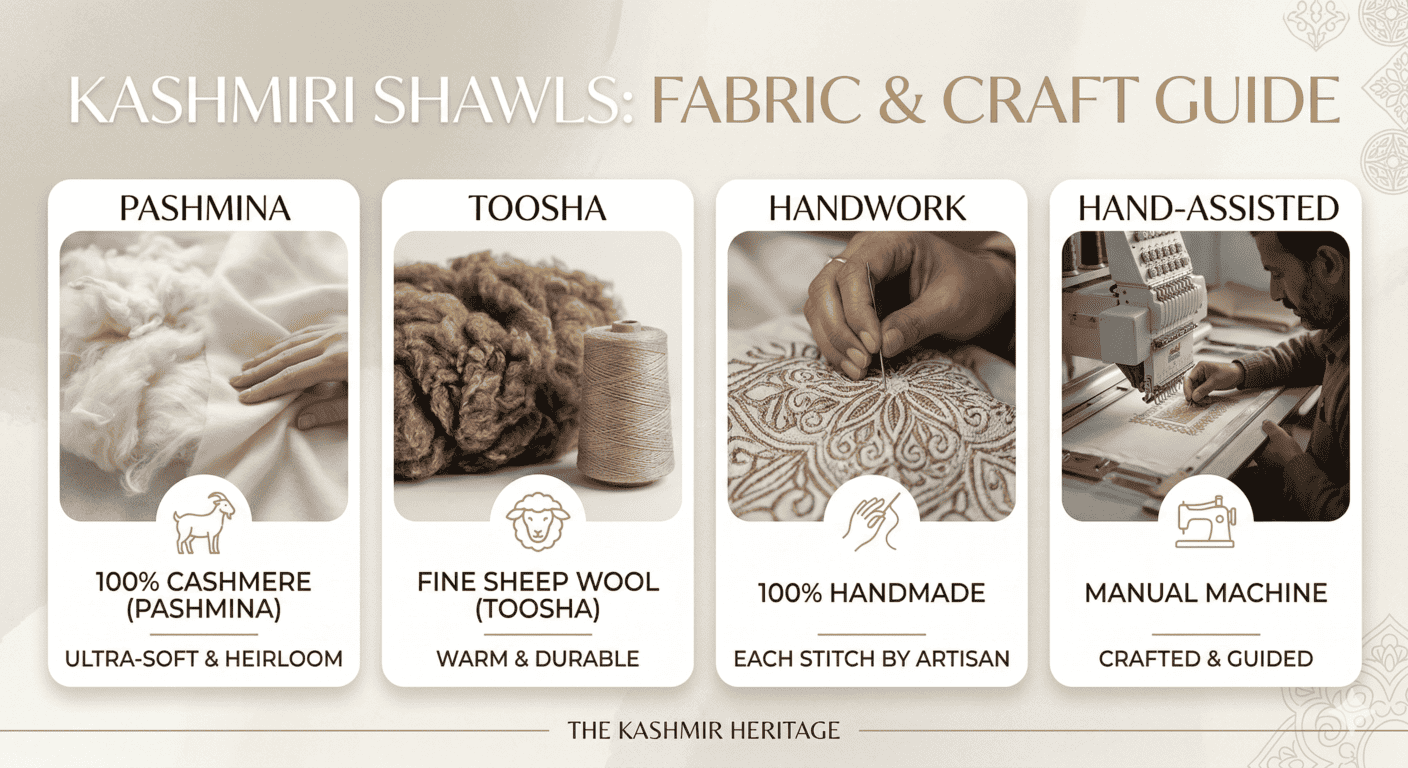
Choosing a Kashmiri shawl is more than a purchase; it is an initiation into a centuries-old legacy. However, with terms like Pashmina, Toosha, and Hand-Assisted floating around, it’s easy to feel overwhelmed.
In this guide, we break down the three pillars of a genuine shawl: the Fabric, the Embroidery, and the History.
The base of your shawl determines its warmth, weight, and how it drapes over your shoulders.
The undisputed “Soft Gold” of the Himalayas. Sourced from the undercoat of the Changthangi goat, these fibers are six times thinner than a human hair.
The Experience: Weightless warmth and a buttery texture that softens with every wear.
The Verdict: The ultimate luxury for connoisseurs.
Historically known as the “King of Wools,” Shahtoosh is the finest fiber in the world, sourced from the Tibetan Antelope (Chiru).
A Note on Ethics: Because the Chiru is an endangered species, the trade of Shahtoosh is strictly banned globally. We mention it here as a tribute to the “Ring Shawl” history, though modern wardrobes now favor the ethical luxury of Pashmina.
In the modern market, Toosha refers to a high-end, superior grade of fine sheep wool.
The Experience: It is warmer and more “structured” than Pashmina. It provides a regal, heavy drape that feels substantial and grand.
The Verdict: The best choice for those who want a durable, high-quality shawl that can support heavy, intricate embroidery.
A masterfully crafted blend of Pashmina and fine wool or silk.
The Experience: It offers the luster of silk and the warmth of cashmere.
The Verdict: Perfect for regular luxury wear, offering a beautiful aesthetic at an accessible price point.
| Fabric Type | Texture & Feel | Best For |
|---|---|---|
| Pashmina | Weightless & buttery | Heirlooms & Weddings |
| Toosha (Fine Wool) | Substantial & regal | Heavy Embroidery |
| Semi-Pashmina | Lustrous & warm | Regular Luxury |
The value of a shawl is often found in the hours of labor stitched into it. Here is how to distinguish between the three main types of work:
The pinnacle of Kashmiri art. An artisan uses a single needle (Sozni) or a hook (Aari) to create patterns one stitch at a time.
Time Invested: 3 months to 2 years.
Identification: Look for slight, charming irregularities. The back of the shawl is almost as neat as the front.
A beautiful middle ground. The artisan manually guides a specialty embroidery machine using their hands and feet to “draw” the design on the fabric.
Time Invested: 1 to 2 weeks.
Identification: More precise and uniform than handwork, but still possesses the soul and direction of a human artist.
Produced on large, computerized industrial looms where the design is pre-programmed.
Time Invested: A few hours.
Identification: Perfectly symmetrical designs. The back usually features a “web” of loose threads or a distinct lining.
| Craft Method | Time Invested | Identification |
|---|---|---|
| Handwork | 3 months – 2 years | Neat back; slight irregularities |
| Hand-Assisted | 1 – 2 weeks | Uniform yet artisan-guided |
| Machine Made | A few hours | Symmetrical; loose threads on back |
If you seek a collector’s item to pass down to your daughter, choose a Hand-worked Pashmina.
If you want a regal, heavy look for a winter gala, a Hand-assisted Toosha is your perfect match.
If you want Kashmiri elegance for your daily wardrobe, our Machine-embroidered collections offer beauty without compromise.
At The Kashmir Heritage, we celebrate every thread of this journey. Which story will you wear?
Discover Your Heritage
From the weightless luxury of pure Pashmina to the regal drape of Toosha, find the piece that tells your story. Every thread is a tribute to centuries of Kashmiri artistry.